What is Rate My Professor? And why do people use it?
Rate My Professor (RMP) is a free online site where students can anonymously rate and write reviews of their professors for anyone to see. With the reviews submitted, RMP assigns a rating of 1-5 to a professor. What started as a mere opinion or review website that students use has unexpectedly become a religious practice when it comes to class registration for students. Students can compare each professor from a certain class to decide which one they would prefer to take. This website has allowed students to gain a small insight into what they’re getting into with each class and ensure that they and their professor are a good fit. Essentially, RMP has become the Yelp for professors and the classes that they teach.
Now, to say these ratings are completely 100% accurate would be an overstatement. With everything in life, everyone has their own experiences and their own opinions. Often, those who write reviews are those very passionate about their opinion. This could very well impact bias if one were to fail a class with a professor, leading them to leave a negative review. With that being said, it’s up to you to decide what you think of the class, how well you’ll be able to perform, and how compatible this professor and class are with you.
Introduction
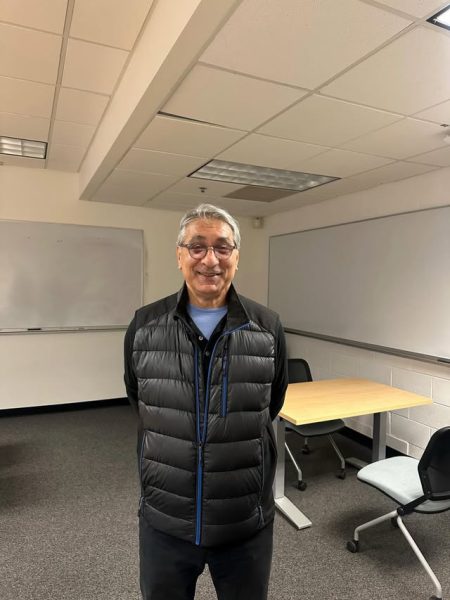
This article’s professor spotlight is the Political Science and Philosophy teacher here at MC, Dr. Aram Hessami. He came here to the United States in the late 70s from his home country, Iran, seeking shelter and education. After studying at Montgomery College and George Washington University for his Bachelor’s and Doctorate in Philosophy and Political Science, He then came back to teach here full-time at Montgomery College for the last 26 years. Having personally taken his class myself, Dr. Hessami is a funny and intellectual professor who takes teaching very seriously. When asked to participate in this segment, he very gladly agreed, saying he hadn’t read his ratings for a long time. Dr. Hessami talked about his life story, his classroom, and read his own ratings. Without further ado, here are the results of this interview.
Advocate: “You studied at MC. What made you want to come back and teach?”
“I got educated here… I teach more of a Socratic and Q&A style, so if students have read the textbook or are interested in international relations, they bring me questions. In a university like Maryland, you can’t engage in that dialogue or conversation, so the small class size is what I liked.”
Advocate: “Who is Aram Hessami?”
“Besides being a professor, I really love making a difference. I came to the USA in 1979; the revolution in Iran had burned our property, my family was homeless and unemployed, so I came here when I was a teen, and found a home in the US. When I think of who I am, the US plays a big part, as I am a product of the American system, where I was given the opportunity to come here through a student Visa, and therefore I am and was a professor to make a difference within the community.”
“My kids say, we dont know anyone more American than you. I always appreciate the opportunity that the US has given me, and I want to make a difference, and I truly believe community and community service is what you leave behind.”
Advocate: “What do you do in your free time?”
“I’m very active in Iranian politics. I try to organize and create a democratic alternative, so I’m very active and use most of my time doing this. If I sleep for 5 hours, it’s a lot. My mind is always racing, trying to solve these puzzles and connect with people, so that’s what I do. For relaxation, I play tennis, basketball, and Texas holdem!”
Advocate: “Do you have a preferred teaching style?”
“In my experience, in order to be able to teach and communicate, you have to build a rapport with the students. I create rapport by showing that I do care that they learn, and that I do care that they are involved, and I encourage them to ask questions that are on their mind. Now, whether they do that is a different story! At the end of the day, I have the enormous task of grading people on whether this work is an A, B, or C; therefore, I have to cover certain content. So through their questions in the Socratic style, I teach the content that is supposed to be covered. Because of this, there is no system; it looks disorganized and different, but it’s because students are so used to PowerPoint presentations. Students’ questions are supposed to drive the discussion.”
“Two years ago, I decided to ban electronics as a whole. It was hard in the beginning, and even difficult now, but the conversation that comes from it builds engagement, and that is what I think is necessary.”
“I try to be extra tough because others pamper students, and there’s a point where they have to take responsibility for what they say and what they study. I’m harder on them because I think the value of higher education is not to implant knowledge in students’ heads, but to engage them and teach them critical thinking.”
Advocate: “People often consider you a genius in your reviews. What do you think about that?”
“I don’t know about genius… I think I come across as thoughtful and fast, which may make people go ‘ah!’ The way I may come across to people makes others think ‘geniuses have no social skills, and they are rude and eccentric.’ It might be because of those labels I get called that people think I’m a genius.”
Advocate: “People say the class feels more like an actual University course. Why do you think that is?”
“It all depends on the students. I could have a student who is 16 and doesn’t have a high school diploma in the same class as I have a PHD in physics and atomic energy. You get this diverse group of people, so the younger students are not used to a professor being this demanding, given that we talk about things like theory, not just facts.”
“It’s also about higher-level learning and thinking. I read one student said, ‘Dr. Hessami thinks he’s teaching at Princeton or Harvard, but this is not Harvard’. They come expecting this is a college and not a university, so I get people saying things like that. I don’t know whether it’s good, bad, or ugly, but it is what it is.”
Advocate: “People often say you’re hard to contact. What’s the best way to contact you?”
“That is the biggest lie, and that is why you shouldn’t trust what you read. I am going to make a claim and publish this. No one is more accessible, at least at Montgomery College, than me.”
“I put my own cell phone number, telling students to call me, open from 7 am to 9 pm. I say, text me! They’re lazy, students want to send an email and just say, I sent an email. If you communicate with text, you’re much more precise, so I put my number on my syllabus. So, it’s not true. Don’t believe it.”
Advocate: “Do you roast people?”
“I ask them to explain what they say. If I roast them, I don’t do it as a combatant. I hope to do it to make you think, and I don’t let you go; I box you in. It comes across as a roast, but I just want you to think. I tell people their answers are wrong because you could mislead the class, so I tell you you got it wrong. If that’s roasting, yes, it’s true I roast.”
Advocate: “Most positive reviews advise you have to know how to study, and if you don’t like authoritative learning, then don’t take the class. What do you think about that?”
“I come to class asking if there are any questions based on readings or what you have been exposed to in the world, so it’s open to discussion for everyone. The problem is that now that everybody thinks that because they have the right to say what they say, it’s informed. I hold them to whether it’s informed, or if its juts a repetition of the media. If you try to fake being informed, it becomes more authoritative, because I say if it’s right or wrong.”
“True, it’s not just that everyone has an opinion, yes, they do, but I’m supposed to teach you political science. Especially if it’s systematic learning, but also scientifically, there is a difference between an informed opinion and an uninformed opinion. I combine the Socratic method but also the Germanic lecture method, as opposed to the British self-study method. Maybe it’s also the way I say things, it sounds more authoritative.”
“I force you to think about the things that you think you know, but you really don’t know, so part of this knowledge is to show the extent of what you know and the presumption of what you don’t know. To me, critical thinking means you constantly question your own beliefs, but also everybody else’s. I ask people even to criticize what I say.”
“Colleges shouldn’t be workforce training facilities, but they should be places to build critical thinking skills, even for your own lives. In order for information to turn into knowledge, you need critical thinking. More importantly, for knowledge to be turned into wisdom, to do the right thing for the right reasons, you need to have critical thinking. When people email me saying, it made a difference, it makes me think; oh my god, it’s working.”
“I’m totally adaptable as well. I can change if things aren’t working. In my recent class, I changed the entire exams and papers in order for students to understand, but at the same time, I’m authoritative.”
Advocate: “Do you consider yourself a friend or a foe?”
“Oh, definitely a friend. I may come across as if I don’t care if I give someone an F or D, but I do. I give chances for students to prove themselves. I think I have two jobs. At the end of the day its not about the paycheck, it’s not just about your duty as a professor, but also your duty to your community, and to your students.”
“My duty is to put on a piece of paper, I certify this person is an A, B, C, D, or F student, and I take that seriously. Now, how do I get you there? I am a friend. I ask you and tell you, if you can’t do these three things, drop this course. If my style is not suitable for you, drop this course. I am your friend to try to teach, but I also try to reduce your failure rate.”
Hessami’s Responses to student reviews
Advocate: “To start with the reviews, you have a collective score of 3.6 out of 5, with over 200 reviews.”
“Is that good or bad? My problem with it is that usually people who like it a lot or people who dislike it a lot, they put their opinion. When it first came out, and I was checking, it’s so amazing that when you compare RMP versus what you actually get on the college’s feedback, it’s so different.”
“I think the most difficult part for my students is that I am a tough grader, they’re not used to this. I don’t deduct points on spelling or grammar, but rather on content. I do care if you’ve learned and if you can show me that youve learned. So some of the bad ratings come from bad grades. That’s my guess.”
The first review was a 5/5 quality, 2/5 difficulty, and the grade was an A+:
“Best class I’ve ever taken. If you are interested in the political field, I definitely recommend Aram Hessami. He knows the material very well, and you will gain a lot of knowledge and perspective from the course.”
“I start with daily politics and daily questions; students can bring anything. Many people work, international students, family obligations, it’s not your normal university, so you have different challenges. And I think that being a good professor is being inspiring, not to inspire people about themselves, but inspire them to learn and think. If a professor does that, it’s good, but others don’t think that way. Others just want the grade, organization, and if you want that, I’m not your man.”
Another review, with a quality of 1, and difficulty of 4, with a grade of an A+:
“The modules were simple enough, but hes very disorganized, and unclear about grading criteria, and also the instructions were very inconsistent for the final paper, he says text is the best way to contact him, but he is unresponsive no matter what method you use. The textbook teaches you, and all the quizzes were written, with no multiple choice.”
“It’s not true that I’m not accessible. They’re not used to my style. This must be an online course because in person, I don’t do many quizzes; I have two exams. But for every chapter, they have a quiz, every topic they have a quiz, maybe every 3 days they have a quiz. I think it’s a challenge with teaching online as they’re not in person, but I give them unlimited attempts to each quiz within 48 hours, so that’s not fair.”
This person gave a quality of 1, and a 5 for difficulty, with no grade:
“He is a decent and knowledgeable person, but he is not a good professor. I suspect he was once a more efficient professor, but time may have taken its toll. Not organized, with arbitrary grading that takes forever.”
“I usually bring grades back within a week, because I know even the redo takes time. I can’t see what goes on in people’s heads; I am indeed very literal. If I tell you to define, describe, and state the significance, then I expect you to do exactly that. I gave examples of what it is to set the expectation too.”
“This is another thing, when you miss one or two classes, I don’t do roll call or force you to come, because I think you should take responsibility for your class, it shows. After exams, I have students read their answers, and I also tell them how I would have answered it. I encourage them to take notes. The grades are not arbitrary; I take them very seriously because some people’s future and prospects depend on the grades.”
This is the last review. This person gave you a 5 out of quality and 3 for difficulty:
“Dr. Aram Hessami reminds us that education is more than job security. This course taught you how to think critically. He provides tools to question our social and political world while inspiring the curiosity to ask. If POLI221 were mandatory, I believe that political discourse would be more genuine, intellectually serious, and just.”
“Someone that I know and passed away, a veteran several years ago, and I didn’t know this until after he passed away: the Dean sent me an email. It said, Aram, this person that passed away, he was diagnosed with some kind of cancer, and on one of his social medias he wrote, ‘I know Dr. Hessami doesn’t care about social media and doesn’t have social media, but I have taken courses at Harvard and Princeton, and Aram Hessami should be teaching there. He makes sure the students are taking the same course, and he makes the students get what they need from higher education through this one course.”
“That was really a compliment to me, much like this one, and it makes you think. I don’t do it for anything, as it comes naturally, as I was also inspired by other teachers who cared. At the end of the day, what is left for us is what we have done for others.”
“Teaching for me and this learning process has to do with that, and I know our culture does not reward teaching or learning. This brings me to online learning, where I think it’s a travesty that I can’t see my students or make them talk or turn their cameras on, I have no way of assessing the validity and integrity of the work they submit, yet I’m forced to grade them and send them into a higher class level. I’m sure as I go, I’ll get worse reviews because I want to make it more difficult for students to fake their knowledge.”
“If I can make students leave knowing the structure of the American government is one thing, but if I can make them think for themselves and make the right decisions, it’s the most important.”
Conclusion
That was all the questions from the interview with Aram Hessami. I hope that these articles can shine light on facility members that are active in the community, and as a reminder, What is supposed to come out of this is aid in students’ class in professor picking, understanding the professor’s teaching style, but also get to know their professor aside from the classroom, but also help professors as they openly discuss what they expect out of students, which often isn’t possible until one has already been enrolled in the class. This is not to degrade or hate on professors in any way, as hatred will never be tolerated. Everything that is shared or asked will be approved by The Advocate team as well as the professor in order to keep a respectful and positive environment.
If you want a professor to be interviewed, or are a professor interested in an interview, comment or email me.
Tania Marquina is a first-year student studying International Studies. She can be reached at [email protected]